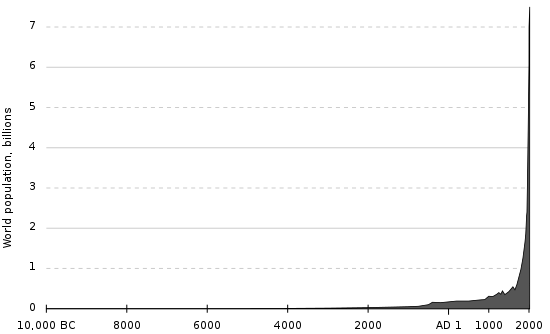
Overpopulation, also known as population explosion, is a
phenomenon that has caused hysteria among scientists and demographic
specialists. Fatalists believe that overpopulation is the path to the
apocalypse. While others think that overpopulation is simply part of the course
of nature. Nonetheless, all agree that overpopulation has had and will continue
to have a large impact on modern day politics.
Overpopulation has become the focus of many discussions and
the axis of many debates, as it is one of the most arguable, debatable and controversial
topics of our time. The question that has yet to find its answer is: Is it really
happening or is it a hoax?
Statistics have shown that the human population of earth that
is now around seven billion, has rapidly tripled in the last seventy years, and
is moving towards nine billion in the next five to six years. According to one
study, for the world to provide a sustainable habitat for mankind, human
population must not exceed four billion.
The People’s Republic of China has been the first to address
this problem by implementing the “One-child policy”. Although many people see China’s
scheme for population control as a violation of human-rights, it has not only
slowed down the rate of population expansion, but has also decreased infant
mortality while dramatically increasing the life expectancy of its people.
Overpopulation has also acquired its share of attention in the
media. Daniel Quinn, the author of a book named Beyond Civilization, has
linked overpopulation to the excessive and unnecessary food demand. He also
stated that humans are not capable of destroying earth, but only able to
destroy it as their habitat.
Population explosion has also appeared in many works of
fiction. An example is Dan Brown’s mystery-thriller novel Inferno, where
the “antagonist” is a geneticist that plans to unleash a deadly plague to solve
the problem of overpopulation. Another example is Christopher Nolan’s upcoming
film Interstellar in which earth can no longer sustain human life form
due to overpopulation and global warming; therefore, humans travel to other
solar systems in search for a new habitat.
On the other hand, there are people that believe that the
rapid population increase is natural and nature has its ways in neutralizing
the effects of this phenomenon. For instance, British author and political
activist Robert Newman believes that the problem is not that there are too many
people on earth but that too few own too much.
A documentary called The Great Population Hoax
analyzes demographic statistics while comparing popular myths regarding
overpopulation with undeniable facts. The documentary states that prosperity
and economic development do not depend on access to land and natural resources as
most of the poorest people in the world live in Africa although it is abundant
with natural resources. Also, rapid population growth and high population
densities are not an obstacle to growth as most populated areas in the world
are the richest. It also states that poor infrastructure is the main cause of
famine, not population growth.
In my opinion, in terms of resources, overpopulation is
indeed a global crisis because as the population rises, food supply must also
rise as the demand increases. Once the world has reached its limits, the developing
countries will fail to support their people.
