Saturday, May 17, 2014

Overpopulation


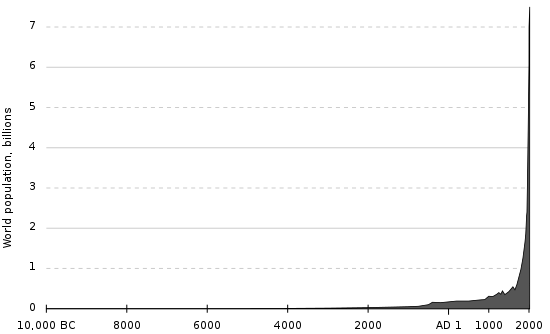
Overpopulation, also known as population explosion, is a phenomenon that has caused hysteria among scientists and demographic specialists. Fatalists believe that overpopulation is the path to the apocalypse. While others think that overpopulation is simply part of the course of nature. Nonetheless, all agree that overpopulation has had and will continue to have a large impact on modern day politics.
Overpopulation has become the focus of many discussions and the axis of many debates, as it is one of the most arguable, debatable and controversial topics of our time. The question that has yet to find its answer is: Is it really happening or is it a hoax?

Statistics have shown that the human population of earth that is now around seven billion, has rapidly tripled in the last seventy years, and is moving towards nine billion in the next five to six years. According to one study, for the world to provide a sustainable habitat for mankind, human population must not exceed four billion.
The People’s Republic of China has been the first to address this problem by implementing the “One-child policy”. Although many people see China’s scheme for population control as a violation of human-rights, it has not only slowed down the rate of population expansion, but has also decreased infant mortality while dramatically increasing the life expectancy of its people.
Overpopulation has also acquired its share of attention in the media. Daniel Quinn, the author of a book named Beyond Civilization, has linked overpopulation to the excessive and unnecessary food demand. He also stated that humans are not capable of destroying earth, but only able to destroy it as their habitat.
Population explosion has also appeared in many works of fiction. An example is Dan Brown’s mystery-thriller novel Inferno, where the “antagonist” is a geneticist that plans to unleash a deadly plague to solve the problem of overpopulation. Another example is Christopher Nolan’s upcoming film Interstellar in which earth can no longer sustain human life form due to overpopulation and global warming; therefore, humans travel to other solar systems in search for a new habitat.

On the other hand, there are people that believe that the rapid population increase is natural and nature has its ways in neutralizing the effects of this phenomenon. For instance, British author and political activist Robert Newman believes that the problem is not that there are too many people on earth but that too few own too much.
A documentary called The Great Population Hoax analyzes demographic statistics while comparing popular myths regarding overpopulation with undeniable facts. The documentary states that prosperity and economic development do not depend on access to land and natural resources as most of the poorest people in the world live in Africa although it is abundant with natural resources. Also, rapid population growth and high population densities are not an obstacle to growth as most populated areas in the world are the richest. It also states that poor infrastructure is the main cause of famine, not population growth.

In my opinion, in terms of resources, overpopulation is indeed a global crisis because as the population rises, food supply must also rise as the demand increases. Once the world has reached its limits, the developing countries will fail to support their people.

Friday, May 16, 2014

Test 1


Q1)
Critical Thinking is a type of rational, reasonable, reflective thinking that aids analysis and decision-making. A critical thinker must be open-minded, analytical, rational and unbiased to be able to truly analyze facts and state valid points.

Q2)
Barriers to critical thinking include:
1-      Egocentricity:                                    when a person believes all topics are relative to oneself.

2-      Prejudice:                                           When a person forms an opinion before looking at the facts.

3-      Social conditioning:                        When a person is brought up to act in a manner that is acceptable by one’s society.

4-      Limited frame of reference:       When a person has little or no background in the matter discussed.

5-      Drone mentality:                             When a person has no interest in the world around him/herself.

An example of prejudice is when a religious person neglects scientific facts from a non-religious person because he/she considers the non-religious person an “infidel”.
An example of limited frame of reference is when a person that neither studied medicine nor read any medical journals or articles but still chooses to debate the cure of HIV with a doctor.

Q3)
A fallacy is when an argument is unjust or invalid due to poor critical thinking and other related factors.

Causes of fallacies may include:
1-      Inability:                                              When someone states that an argument is wrong because on
                                                               cannot understand it.

2-      Ignorance:                                          When a person believes something is true because he/she
 cannot prove or disprove it.
3-      Personalizing an argument:             When a person verbally attacks his opponent in a debate rather
  than his argument.

4-      Norms and beliefs:                         When a person refuses to accept the facts of another person’s
argument because it contradicts with his beliefs, whether religious, social or personal.

5-      Assuming all criticism is negative (example):
When a religious person criticizes evolution, an agnostic or atheist might call the religious person delusional. When a non-religious person criticizes genesis, the religious person might call the non-religious person crazy or ignorant.


Q4)
Benefits of critical thinking:
-          Increased attention to detail.
-          Increased observation.
-          Versatile analyzing skills.
-          Ability to read between the lines.
-          Ability to conclude the key points of a message or text, without being distracted with meaningless details.

A critical thinker is a keen observer and is very attentive to detail. Critical thinking is considered a soft skill that with time and practice develops into insight and intuition which enables critical thinkers to apply their skills in a wide variety of fields and tasks, ranging from administrative work to technical and even critique of film, literature, music and art.

Wednesday, March 5, 2014

Barriers to critical thinking


General barriers of critical thinking may include the following:

1- Cultural conditioning.
2- Egocentric thinking.
3- Prejudice.
4- Reluctance.
5- Lack of confidence.
6. Consensus.
7. Hasty moral judgement.
8. Black and white thinking.
9. Resistance to change.
10. Limited frame of reference.


Sources:
* http://www.palomar.edu/reading/Thomsons120/Blocks%20to%20Critical%20Thinking.htm

* http://www.preparedirect.com/category_s/183.htm

Tuesday, March 4, 2014

Benefits of critical thinking


Good critical thinking involves:

·        Improved attention & observation

·        More focused reading

·        Improved ability to identify key points in a text or meassage and not being distracted by less important material

·        Knowledge of how to get your own point across more easily

·        Skills of analysis that you can apply to various situations

Ancillary skills:

·        Observation

·        Reasoning

·        Decision-making

·        Analysis

·        Judgement

·        Persuasion


Realistic self-appraisal

Many people probably over-estimate their critical thinking skills


Emotional self-management

We may not like evidence that contradicts our own opinions or beliefs


Perseverance, accuracy  precision

Critical thinking involves accuracy  & precision & a dedication to finding the correct answer. It includes:

     Attention to detail

     Identifying trends & patters

     Repetition

    Taking different perspectives

   Objectivity     Considering implications & distant consequences

Monday, March 3, 2014

Al Gore's An Inconvenient Truth


An Inconvenient Truth is basically a documentary film about former US vice-president Al Gore’s campaign to raise awareness on global warming and climate change.

The films major premise was to make people around the globe more aware of their impact on their one and only habitat, Earth. Al Gore, through his presentations showered his audience with “scientific” claims predicting an apocalyptic future.

It may appear that Al Gore seems to have a pure intention and a heart keen to make a change in this world, but he may have made a few errors in his speech. One error for example, is claiming that the melting of the glaciers on Mount Kilimanjaro was an after effect of climate change, while the majority of scientists have proven that it was due to deforestation. 

All charts displayed by the former vice-president show a linear relation between carbon emissions and global temperatures, but according to Al Gore, charts that predict the future show that carbon emission has an exponential relation with global temperatures, which makes me doubt the credibility of his claims.

Once again, although Al Gore’s presentations displayed many errors,  there is no doubt that we are all harming our environment, and Gore’s work acted as a wake-up call for many countries, corporations and individuals. To conclude, I can only say Al Gore is a very talented politician.